Canterbury-Bankstown Exempt Tree List
Council-listed tree species exempt from removal or pruning approval, and the conditions that apply.
Under Chapter 2.3 of the Canterbury-Bankstown Development Control Plan, Council identifies specific tree species that are exempt from the approval requirements applying to trees on private land. Being on this list does not automatically mean every tree of that species can be removed without any further check. Some species carry specific size conditions, and other exclusions can still apply.
- AQF Level 5 Consulting Arborists
- 32+ years arboricultural experience
- Council-ready documentation
- Fast-track reporting available
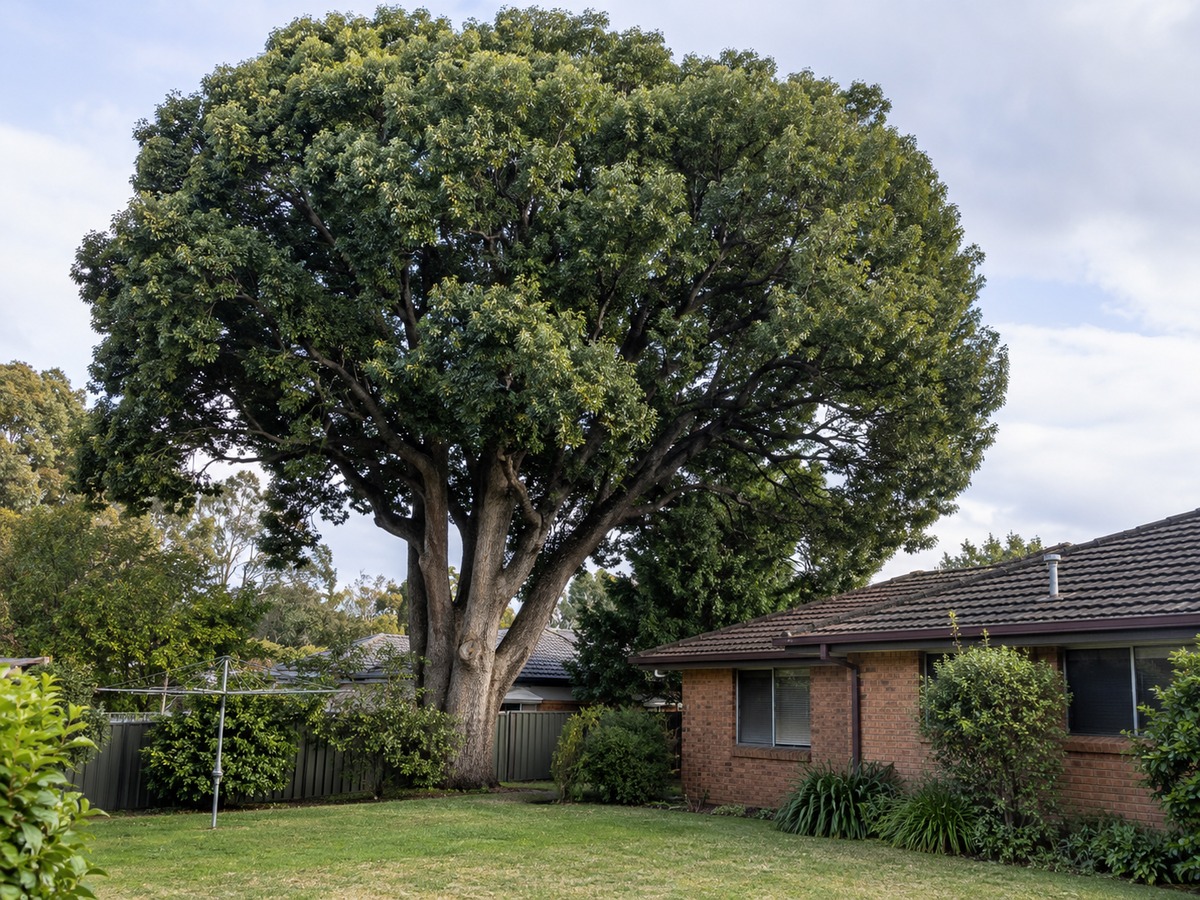
Canterbury-Bankstown's exempt species list
The species exemption applies under Council's provisions for trees on land other than public land. Trees on Council-managed streets, parks and other public land follow separate Council controls.
41 species listed
| Scientific name | Common name |
|---|---|
| Acacia baileyana | Cootamundra Wattle |
| Acacia podalyriifolia | Queensland Silver Wattle |
| Acacia saligna | Golden Wattle |
| Ailanthus altissima | Tree of Heaven |
| Bambusa spp. | Bamboo |
| Celtis sinensis | Hackberry |
| Cinnamomum camphora | Camphor Laurel, less than 10m in height |
| Citrus limon cvs. | Lemon Tree |
| Citrus reticulata cvs. | Mandarin Tree |
| Citrus sinensis cvs | Orange Tree |
| Citrus x paradisi cvs | Grapefruit Tree |
| Eriobotrya japonica | Loquat Tree |
| Erythrina x sykesii | Common Coral Tree |
| Eucalyptus nicholii | Narrow-leafed Peppermint |
| Eucalyptus scoparia | Willow Gum |
| Ficus elastica and cvs. | Rubber Tree |
| Gleditsia triacanthos | Honey Locust |
| Ligustrum lucidum | Broad-leaf Privet |
| Ligustrum sinense | Narrow-leaf Privet |
| Liquidambar styraciflua | Liquidambar |
| Malus domestica and cvs. | Apple Tree |
| Mangifera indica | Mango Tree |
| Morus spp. | Mulberry Tree |
| Musa spp. | Banana |
| Olea europaea subspecies africana | African Olive |
| Phoenix canariensis | Canary Island Date Palm, with a trunk less than 4m in height |
| Phyllostachys spp. | Rhizomatous Bamboo |
| Pinus radiata | Radiata Pine Tree |
| Populus spp. | Poplars |
| Prunus avium / P. cerasus and cvs. | Cherry Tree |
| Prunus persica and cvs. | Peach Tree |
| Prunus spp. and cvs. | Plum Tree |
| Prunus spp. and cvs. | Apricot Tree |
| Pyrus communis and cvs. | European Pear |
| Robinia pseudoacacia and cvs | Robinia |
| Salix spp. | Willow Tree |
| Schefflera actinophylla | Umbrella Tree |
| Schinus terebinthifolius | Broad-leaf Pepper Tree |
| Syagrus romanzoffiana | Cocos Palm |
| Toxicodendron succedaneum | Rhus Tree |
| X Cupressocyparis leylandii and cvs. | Leyland Cypress |
Two species carry a size condition
Camphor Laurel, Cinnamomum camphora, is exempt only where the tree is less than 10 metres in height. Canary Island Date Palm, Phoenix canariensis, is exempt only where the trunk is less than 4 metres in height. If your tree exceeds either threshold, the species exemption does not apply and the tree may require Council approval.
Common exempt species at a glance
A summary for convenience only. Always check the full list above, since a tree that sounds similar to one of these categories may not be the exact species listed.
Common fruit trees
Lemon, Orange, Mandarin, Grapefruit, Apple, Mango, Mulberry, Cherry, Peach, Plum, Apricot and European Pear. Chapter 2.3 also contains a separate exemption for recognised horticultural varieties of trees grown for fruit production.
Ornamental and invasive species
Liquidambar, Privet, Tree of Heaven, African Olive and Rhus Tree, plus Camphor Laurel subject to its 10-metre height condition.
Palms and bamboo
Cocos Palm, Canary Island Date Palm subject to its 4-metre trunk-height condition, and the listed bamboo genera.
What does exempt actually mean?
Where a tree is one of Council's listed exempt species and any condition attached to that species is satisfied, the species exemption may allow removal or pruning without a Council permit.
This exemption sits alongside, and is separate from, Canterbury-Bankstown Council's other private-tree exemptions, including the under-5-metre exemption, the 3-metre dwelling-proximity exemption, the imminent-threat exemption, and the selective-pruning exemption for non-exempt species. Chapter 2.3 also contains a separate exemption for a dying or dead tree where Council is satisfied that the tree is dying or dead, its condition was not caused by tree vandalism or a breach of Chapter 2.3, and the tree is not required as habitat for native fauna.
Council information last verified 3 September 2026. Council's exempt species list can change, so for a determination specific to your tree, confirm current requirements with Canterbury-Bankstown Council or arrange a site assessment.
Even where a species exemption applies, confirm that
- The tree is genuinely the listed species, not a similar-looking one
- Any size condition attached to that species is met
- The tree is not on public land, where this exemption does not apply
- No separate planning, heritage, biodiversity or other legal requirement applies to the proposed work
Not sure what species your tree is?
Tree species can be difficult to identify reliably from general appearance alone. Send us photographs of the tree, foliage, bark and any flowers or fruit, and we can make an initial identification and advise whether further assessment is needed before you rely on an exemption.
What if my tree is not on this list?
Most protected trees in Canterbury-Bankstown are not exempt species, and will require Council approval for removal or significant pruning unless another exemption applies.
Where no exemption applies, our AQF Level 5 Consulting Arborists can assess the tree and prepare the arboricultural evidence needed to support a Council application.
Other exemptions can include
- Trees less than 5 metres in height
- Trees within 3 metres of an approved dwelling
- Trees genuinely presenting an imminent threat to human life or property
- Selective pruning within Council’s percentage and branch-diameter limits
- Recognised horticultural fruit varieties
- A dying or dead tree meeting the Chapter 2.3 conditions
Frequently asked questions
Send us a photograph of the tree and we will help confirm the species and whether the exemption applies.
Is Camphor Laurel exempt in Canterbury-Bankstown?
Yes, but only where the tree is less than 10 metres in height. A Camphor Laurel at or above that height does not qualify for the species exemption and may require Council approval.
Can I remove a Liquidambar without a permit?
Yes. Liquidambar styraciflua appears on Council’s exempt species list without a size condition attached.
Is a Canary Island Date Palm exempt?
Only where the trunk is less than 4 metres in height. Above that height, the species exemption does not apply.
Is a Cocos Palm exempt in Canterbury-Bankstown?
Yes. Syagrus romanzoffiana appears on Council’s exempt species list without the specific trunk-height condition that applies to the Canary Island Date Palm.
Are fruit trees exempt in Canterbury-Bankstown?
Many common fruit and citrus trees appear directly on the exempt species list, including Lemon, Orange, Mandarin, Grapefruit, Apple, Mango, Mulberry, Cherry, Peach, Plum, Apricot and European Pear. Council also separately exempts recognised horticultural fruit varieties more broadly.
Does the exempt species list apply to street trees?
No. Property owners should not rely on this private-tree species exemption to remove or prune a Council street or park tree. Council-managed trees follow a separate pathway.
Is a dead or dying tree automatically exempt from Council approval?
A dying or dead tree can be exempt where Council is satisfied that the tree is dying or dead, its condition was not caused by tree vandalism or a breach of Chapter 2.3, and the tree is not required as habitat for native fauna. Where those conditions are uncertain, confirm the pathway before removal.
My tree is not on the list. What now?
Most trees that are not listed will require Council approval unless a different exemption applies, such as the under-5-metre exemption, the 3-metre dwelling exemption, the dying or dead tree exemption or the imminent-threat exemption. We can assess your tree and confirm the appropriate pathway.
Official Council sources
- Canterbury-Bankstown Development Control Plan 2023, Chapter 2.3
Council’s Tree Management Order, including the full exempt species list and applicable conditions.
- Canterbury-Bankstown Council, Private Trees
Exemptions, permit applications and replacement planting for private trees.
- Canterbury-Bankstown Development Control Plan 2023
Council’s full development control plan.
Official source links checked 3 September 2026.
Not sure which arborist report you need?
Send us your plans, Council correspondence or photographs of the tree. Our AQF Level 5 Consulting Arborists can identify the appropriate assessment, explain the next step and provide a fixed quote before work begins.