
Project Arborist Services Canterbury-Bankstown
AQF Level 5 Consulting Arborists managing tree compliance from development approval to project completion.
Our AQF Level 5 Consulting Arborists provide Project Arborist services throughout the Canterbury-Bankstown Local Government Area, helping builders, developers, architects, engineers, certifiers and project managers manage retained trees and arboricultural compliance throughout construction.
If your Development Consent requires an appointed Project Arborist, tree-protection inspections, excavation monitoring, arboricultural hold points or compliance certification, we can manage those requirements from pre-construction through to project completion. Wherever practicable, the same Consulting Arborist who prepares your Development Arborist Report or AIA continues as the nominated Project Arborist.
- AQF Level 5 Consulting Arborists
- Construction monitoring
- 32+ years arboricultural experience
- Council-ready documentation
What does a Project Arborist do?
A Project Arborist manages arboricultural requirements relating to retained trees during construction. Depending on the Development Consent and approved plans, this may include:
- Reviewing arboricultural conditions of consent
- Inspecting tree protection measures
- Monitoring retained trees and Tree Protection Zones
- Attending required arboricultural hold points
- Supervising excavation near retained trees
- Assessing exposed or affected roots
- Documenting unexpected tree impacts or departures
- Advising builders and contractors
- Preparing construction-stage compliance reports
- Providing arboricultural certification where required
The objective is to protect retained trees while helping construction proceed in accordance with the approved plans and Development Consent.
When should you appoint one?
Where Project Arborist involvement is required, appointment should occur before the first arboricultural condition or hold point is due. Early appointment allows the Project Arborist to review the Development Consent, the approved architectural and landscape plans, the Arboricultural Impact Assessment, the Tree Protection Plan, the required inspections and hold points, and tree-protection requirements before site works begin.
Common trigger points include before demolition, site establishment, tree-protection installation, excavation near retained trees, or other construction activities identified in the Development Consent. Appointing the Project Arborist after work has already occurred can make it more difficult to demonstrate compliance with conditions that required prior inspection or supervision.
Project Arborist workflow
A clear arboricultural record from pre-construction through to completion.
Review Development Consent
We review the approved plans, arboricultural reports and relevant tree conditions to identify the Project Arborist requirements and construction-stage hold points.
Establish tree protection
Tree protection measures are checked before relevant construction activities begin.
Monitor construction
Required inspections are undertaken as construction progresses, particularly where work occurs within or near Tree Protection Zones.
Manage tree impacts
Where excavation, root exposure or unexpected site conditions affect retained trees, the arboricultural implications can be assessed and documented.
Report and certify
Construction-stage reports and certification are prepared where required by the Development Consent.
Construction monitoring and arboricultural hold points
Development Consents can require Project Arborist inspections at specific stages of construction. These hold points may occur before or during activities such as:
- Installation of tree protection measures
- Demolition near retained trees
- Excavation within or near a Tree Protection Zone
- Footing or foundation excavation
- Driveway construction
- Installation of underground services
- Root pruning where approved
- Removal or alteration of tree protection measures
- Final inspection of retained trees
The exact inspections depend on the Development Consent and approved plans for the individual project. Our role is to attend the required stages, assess relevant tree impacts and provide the documentation needed to demonstrate arboricultural compliance.
Tree protection during construction
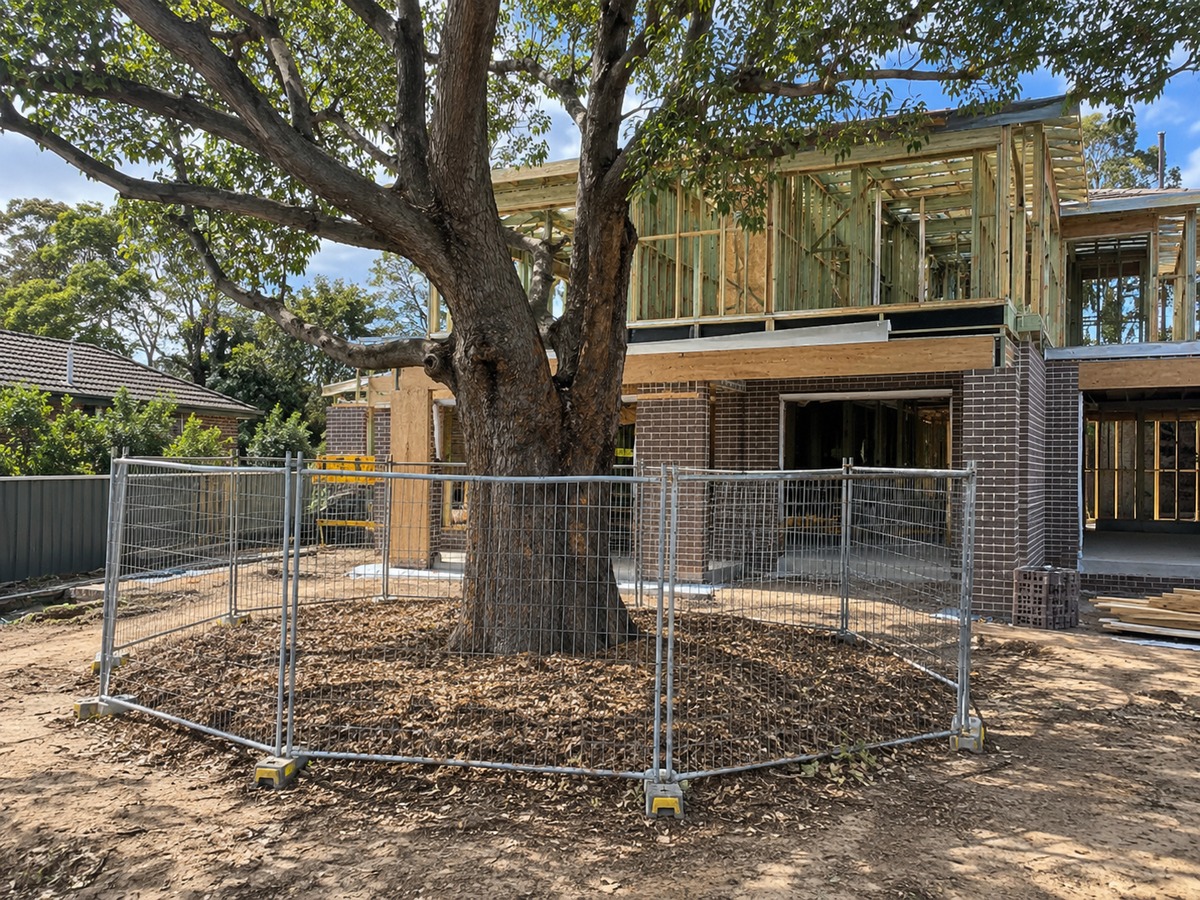
Construction activities can damage retained trees before symptoms become visible. Project Arborist involvement may include monitoring Tree Protection Zones, Structural Root Zones, protective fencing, ground, trunk or branch protection, excavation near retained trees, machinery access, material storage, service installation, and changes affecting approved tree-protection measures.
Canterbury-Bankstown Council identifies fenced Tree Protection Zones as its preferred form of tree protection. Its standard development conditions typically restrict vehicle access, excavation, services, building materials, chemical storage, site sheds, washout areas and waste material within the fenced TPZ. Council's current development guidance references AS 4970-2025, Protection of trees on development sites.
Where a fenced TPZ cannot be provided and alternative ground, trunk or branch protection is required, Council states that an AQF Level 5 Consulting Arborist will usually be required to design or supervise those measures.
Excavation, roots and unexpected tree impacts
Excavation near retained trees is one of the construction stages where Project Arborist involvement can be particularly important. Where roots are encountered, the Project Arborist may assess root size and location, likely structural or physiological significance, the relationship to the approved Tree Protection Zone, whether excavation can proceed as proposed, whether further investigation is required, and appropriate arboricultural management.
Where more detailed information is needed, non-destructive root investigation can help establish root location and distribution before construction decisions are made. Unexpected impacts should also be documented where construction conditions differ from the approved plans or arboricultural assumptions.
Compliance reporting and certification
Project Arborist documentation may be required throughout construction or at completion. Depending on the Development Consent, this can include:
- Inspection records
- Photographic documentation
- Tree-protection compliance reports
- Excavation or root-monitoring records
- Documentation of unexpected impacts
- Recommendations for corrective measures
- Construction-stage certification
- Final arboricultural compliance reporting
Where certification is required, it should reflect the inspections actually undertaken and the relevant requirements of the Development Consent and approved plans. This is why appointing the Project Arborist before required hold points occur is important.
Development projects and project teams
We provide Project Arborist services for residential, commercial, industrial, community and infrastructure developments, from new homes and duplexes through to apartments, childcare centres, commercial buildings, warehouses and larger projects.
Continuity from AIA to construction
Wherever practicable, the same Consulting Arborist continues from the development assessment stage through construction, giving consistent arboricultural decisions.
Construction compliance
Review of Development Consent conditions, required inspections, hold points, reporting and certification.
Project team coordination
Clear arboricultural advice for builders, developers, architects, engineers, Principal Certifiers, planners, landscape architects, surveyors and utility contractors.
Frequently asked questions
If your question is not here, send us the details and we will tell you what applies.
When is a Project Arborist required?
A Project Arborist may be required where Development Consent conditions require arboricultural supervision, tree-protection inspections, excavation monitoring, construction-stage reporting or compliance certification for retained trees.
When should I appoint the Project Arborist?
Before the first required arboricultural hold point or tree-protection condition is due. This allows the consent conditions, approved plans and protection requirements to be reviewed before relevant site works begin.
Can the same arborist prepare the AIA and supervise construction?
Yes. Wherever practicable, the same AQF Level 5 Consulting Arborist who prepares the Development Arborist Report or AIA can continue as the Project Arborist, providing continuity throughout the project.
What inspections does a Project Arborist undertake?
The inspections depend on the Development Consent. They may include tree-protection inspections, excavation and root monitoring, construction-stage hold points, assessment of unexpected impacts and final inspections of retained trees.
Can you provide compliance certification?
Yes. Where required, we prepare arboricultural compliance reports and certification relating to the Development Consent conditions and retained trees.
Project Arborist services throughout Canterbury-Bankstown
Construction-stage arboricultural services across all five wards.
Darani / Bankstown Ward
Bankstown, Chullora, Greenacre, Mount Lewis and part of Punchbowl.
Bura / Bass Hill Ward
Bass Hill, Birrong, Chester Hill, Condell Park, Georges Hall, Lansdowne, Potts Hill, Regents Park, Sefton, Villawood and Yagoona.
Budjar / Canterbury Ward
Ashbury, Belfield, Campsie, Canterbury, Clemton Park, Croydon Park, Earlwood and Hurlstone Park.
Bunya / Revesby Ward
East Hills, Milperra, Padstow, Padstow Heights, Panania, Picnic Point, Revesby and Revesby Heights.
Bunmarra / Roselands Ward
Belmore, Beverly Hills, Kingsgrove, Lakemba, Narwee, Riverwood, Roselands, Wiley Park and part of Punchbowl.
Official Council sources
- Canterbury-Bankstown Council, Trees and Development
Official Council information about trees affected by development, tree protection and development conditions.
Official source links checked 3 September 2026.
Related pages
Council information last verified 3 September 2026. Project-specific requirements should be confirmed against the Development Consent and approved plans.
Not sure which arborist report you need?
Send us your plans, Council correspondence or photographs of the tree. Our AQF Level 5 Consulting Arborists can identify the appropriate assessment, explain the next step and provide a fixed quote before work begins.