
Tree Root Investigation & Mapping Canterbury-Bankstown
AQF Level 5 non-destructive root investigation, AirSpade excavation and CAD root mapping for development.
Tree Root Investigation is particularly valuable where proposed buildings, footings, driveways, swimming pools, retaining walls, services or excavation occur within or near the root zone of a retained tree.
Using AirSpade excavation where required and CAD-integrated root mapping, we can establish the location, size, depth and distribution of significant roots and relate those findings directly to architectural, engineering and development plans. This provides physical evidence that can assist architects, engineers, builders and Council when assessing development impacts and considering practical options for tree retention.
- AQF Level 5 Consulting Arborists
- AirSpade root investigation
- CAD root mapping
- 32+ years arboricultural experience
What is a tree root investigation?
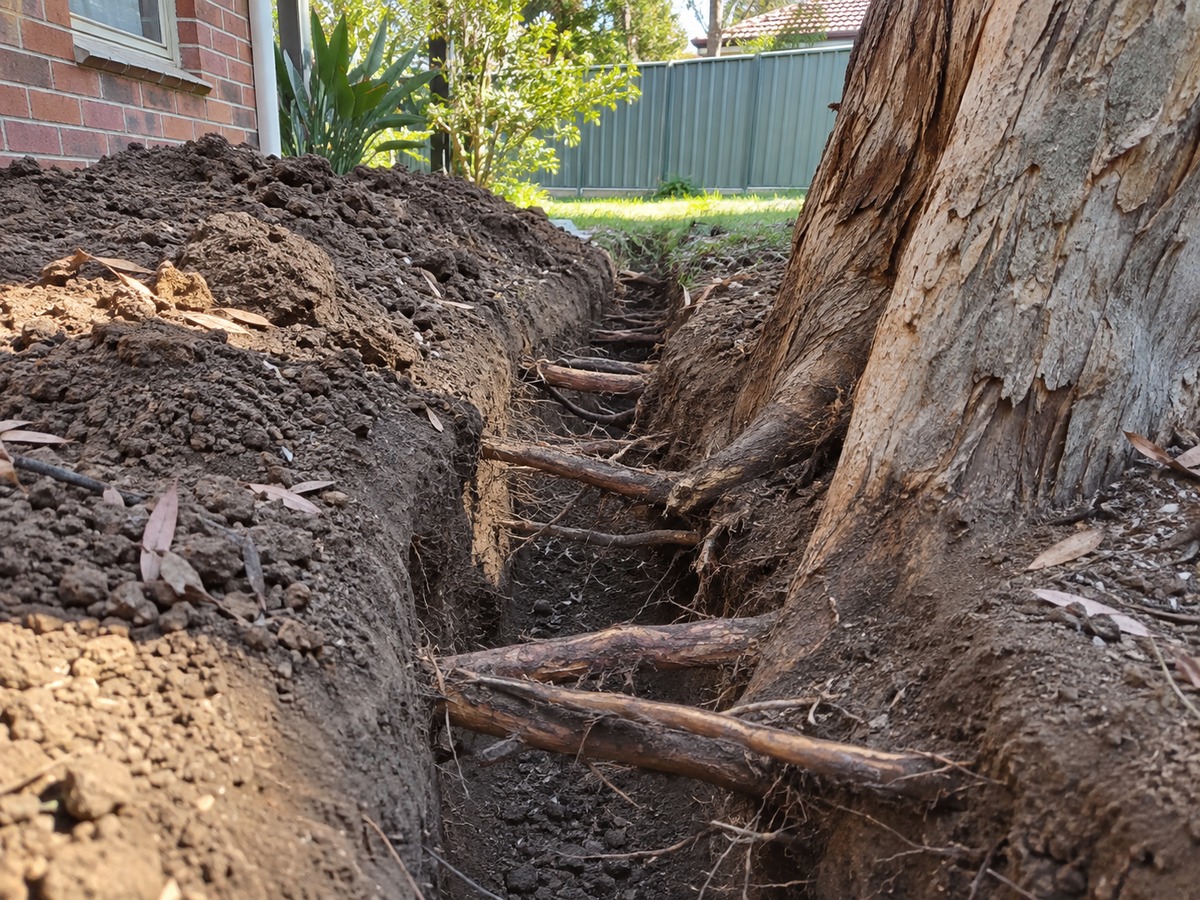
Tree roots cannot be accurately located from above ground alone. A Tree Root Investigation establishes where significant roots actually occur so proposed development can be assessed against the tree's below-ground structure rather than relying solely on assumptions based on trunk location.
Investigation may be appropriate where proposed works interact with a retained tree's root zone and the location or significance of roots needs to be established before design, approval or construction proceeds. This may include buildings and footings, basements, driveways, swimming pools, retaining walls, drainage, underground services, excavation and proposed root pruning.
Establishing root location early can help architects and engineers respond to actual site conditions before designs are finalised, reducing unnecessary redesign and identifying practical opportunities for retaining trees.
What we assess
- Root location
- Root diameter
- Root depth
- Root distribution
- Significant structural roots
- Interaction with proposed works
- Tree Protection Zone considerations
- Structural Root Zone considerations
Relevant roots can be measured, photographed and mapped against the proposed development.
How we investigate and map tree roots
Non-destructive excavation methods wherever appropriate, to expose roots while minimising unnecessary damage.
AirSpade root investigation
Where physical root exposure is required, an AirSpade uses compressed air to remove soil from around roots. Compared with conventional mechanical excavation, it can expose roots while reducing the risk of unnecessary cutting or tearing of the root system, and establish whether significant roots are present within a proposed excavation area.
CAD root mapping
Root investigation findings can be integrated with architectural, engineering or survey plans to show the location of significant roots in relation to proposed works, so the project team can consider root information alongside building footprints, footings, services and driveways.
Arboricultural assessment
Findings are assessed against the proposed construction, Tree Protection Zone and Structural Root Zone considerations, then integrated into the design.
Root mapping for Development Applications
Where development occurs close to retained trees, root mapping can provide direct evidence about the relationship between proposed construction and existing roots. The findings can support Development Arborist Reports, Arboricultural Impact Assessments, Development Applications, engineering and footing design, construction methodology, Tree Protection Plans, excavation planning and alternative design options.
Canterbury-Bankstown Council states that healthy trees should be protected throughout development and that development conditions may be imposed in accordance with AS 4970-2025, Protection of trees on development sites. Accurate root information can help determine whether proposed works can proceed around existing roots or whether the design or construction methodology should be modified.
Roots, foundations and infrastructure
Tree roots can interact with buildings and infrastructure in different ways, so visible cracking or lifting does not automatically establish that a tree is responsible. Roots can physically interact with driveways and paving, retaining walls, drainage, sewer and stormwater infrastructure, lightweight structures and existing footings. Trees may also influence soil moisture conditions, particularly where reactive soils are present.
A root investigation can provide physical evidence of whether roots are present in the affected area, which can assist an arborist, engineer or other consultant in determining the cause and appropriate response. Council states that minor structural effects, such as minor lifting of fences, pathways, garden edging and carport slabs due to roots, are generally not sufficient grounds by themselves for tree removal or pruning.
Root pruning and construction near retained trees
Roots should not simply be cut because they conflict with proposed construction. Root pruning can affect tree health and, where significant structural roots are involved, potentially affect tree stability.
Council's current development guidance prohibits excavation and installation of services within a fenced Tree Protection Zone under its standard conditions for protecting a retained tree, and requires utilities, pipes, stormwater lines and pits to be located outside the fenced TPZ.
Where development cannot avoid roots, investigation can help determine whether construction can be repositioned, footing design can be modified, services can be redirected, alternative construction methods are appropriate, root pruning is arboriculturally acceptable, or further design changes are necessary. The strongest time to establish this is before excavation begins, rather than after significant roots have already been encountered on site.
What a root investigation report provides
- Investigation locations
- Exposed root locations
- Root diameter and depth information
- Photographic evidence
- CAD-integrated root mapping
- Assessment of proposed construction impacts
- TPZ and SRZ considerations
- Arboricultural recommendations
- Design or construction considerations
The findings can then be incorporated into the appropriate development documentation and used by architects, engineers, builders and other project consultants. For projects that progress into construction, our AQF Level 5 Consulting Arborists can also provide Project Arborist monitoring where required.
Frequently asked questions
If your question is not here, send us the details and we will tell you what applies.
When is a tree root investigation required?
A root investigation may be appropriate where proposed excavation or construction occurs close to retained trees and the location or significance of roots needs to be established before design, approval or construction proceeds.
When should root investigation be undertaken?
Ideally before architectural and engineering designs are finalised where proposed works interact with a retained tree’s root zone. Early investigation allows root information to influence building, footing, service and excavation design before construction begins.
Can roots be investigated without mechanical excavation?
Yes. Where appropriate, AirSpade excavation uses compressed air to expose roots while minimising the unnecessary root damage associated with conventional mechanical excavation.
Can root investigation help retain a tree?
Often. Establishing where significant roots actually occur may allow architects and engineers to modify the design, footing system, service alignment or construction methodology while retaining the tree.
Can you investigate whether roots are affecting a driveway or building?
Yes. Root investigation can establish whether tree roots are physically present in the affected area. Where structural movement or soil behaviour is involved, engineering assessment may also be appropriate.
Root investigation throughout Canterbury-Bankstown
Non-destructive investigation and CAD mapping across all five wards.
Darani / Bankstown Ward
Bankstown, Chullora, Greenacre, Mount Lewis and part of Punchbowl.
Bura / Bass Hill Ward
Bass Hill, Birrong, Chester Hill, Condell Park, Georges Hall, Lansdowne, Potts Hill, Regents Park, Sefton, Villawood and Yagoona.
Budjar / Canterbury Ward
Ashbury, Belfield, Campsie, Canterbury, Clemton Park, Croydon Park, Earlwood and Hurlstone Park.
Bunya / Revesby Ward
East Hills, Milperra, Padstow, Padstow Heights, Panania, Picnic Point, Revesby and Revesby Heights.
Bunmarra / Roselands Ward
Belmore, Beverly Hills, Kingsgrove, Lakemba, Narwee, Riverwood, Roselands, Wiley Park and part of Punchbowl.
Official Council sources
- Canterbury-Bankstown Council, Trees and Development
Official Council information about trees affected by development, tree protection and development conditions.
Official source links checked 3 September 2026.
Related pages
Council information last verified 3 September 2026. Project-specific requirements should be confirmed against the Development Consent and approved plans.
Not sure which arborist report you need?
Send us your plans, Council correspondence or photographs of the tree. Our AQF Level 5 Consulting Arborists can identify the appropriate assessment, explain the next step and provide a fixed quote before work begins.