Tree Health & Safety Assessments Canterbury-Bankstown
AQF Level 5 tree reports, tree risk assessment and structural and health assessment.
A tree may look healthy while containing significant structural defects. Conversely, a tree with a cavity, lean, deadwood or declining canopy does not necessarily present an unacceptable risk. Our assessments examine the available arboricultural evidence to determine the tree's condition, identify significant defects, assess risk and provide appropriate management recommendations.
Immediate hazard, active tree failure or a fallen tree? See emergency tree removal Canterbury-Bankstown.
- AQF Level 5 Consulting Arborists
- QTRA and TRAQ qualified
- 32+ years arboricultural experience
- Resistograph investigation
What is a Tree Health & Safety Assessment?
A professional arboricultural assessment of a tree's health, structural condition and potential risk. The tree is assessed as a whole rather than judged by a single visible defect, which can include canopy condition, trunk and branch structure, root-zone observations, previous failures, site conditions and potential targets.
The objective is to determine whether management is required and what response is proportionate to the condition identified. Recommendations may include retention, monitoring, pruning, further investigation or removal where supported by the arboricultural evidence.
When should you have a tree assessed?
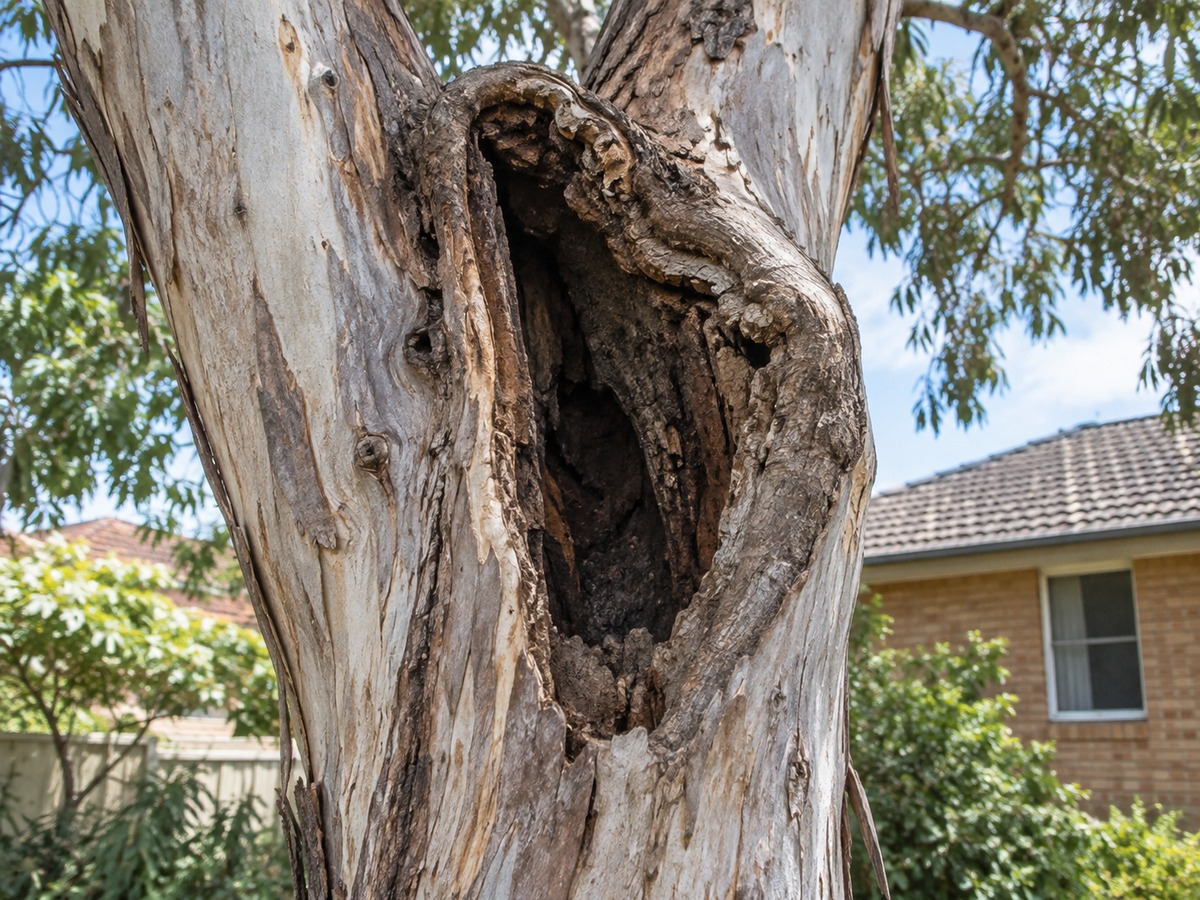
- Cracks, splits or cavities
- Visible decay or hollowing
- Large dead or failing branches
- Significant canopy dieback or decline
- Fungal fruiting bodies
- Unusual or increasing lean
- Root damage or disturbance
- Soil movement around the root plate
- Previous branch or stem failures
- Storm damage
- Construction activity close to the tree
- A significant change in the tree’s condition
Assessment may also be appropriate where a large tree is close to a dwelling, driveway, footpath, school, commercial area or other frequently occupied space and there is concern about its condition.
Health and structural condition
Tree health and structural condition are related, but they are not the same. Health assessment may consider canopy density, foliage condition, deadwood, dieback, growth patterns, wounds, pest or disease symptoms, fungal activity and environmental stress. Structural assessment considers the trunk, major stems, branches and visible root zone for significant defects such as decay, cavities, cracking, weak unions, previous failures, root damage and abnormal movement.
Poor health does not automatically mean a tree is structurally unsafe. Likewise, the presence of a structural defect does not automatically mean the tree requires removal. Its significance depends on the type, location and extent of the defect and its relationship to the tree's overall structure.
How we assess tree risk, QTRA and TRAQ
Our AQF Level 5 Consulting Arborists hold recognised tree risk assessment qualifications, including QTRA and TRAQ. Tree risk is not determined by defects alone. Assessment may consider:
- The tree or part of the tree that could fail
- The likelihood of failure
- People, property or infrastructure that could be affected
- The potential consequences of failure
- Site occupancy and use
- Whether risk can reasonably be reduced through management
Potential targets may include people, dwellings, neighbouring properties, vehicles, driveways, footpaths, play areas and entrances. The objective is not to automatically justify removal. It is to establish the significance of the condition identified and recommend a proportionate response.
What management options may be recommended?
The appropriate response depends on the tree, the defect, site use and level of risk identified.
- Retention without immediate intervention
- Monitoring or reassessment
- Deadwood removal
- Selective pruning
- Reduction or weight management where appropriate
- Management of the surrounding target area
- Further diagnostic investigation
- Root investigation
- Removal where justified by the findings
Where a tree can reasonably be retained through proportionate management, that option should be considered. Where removal is recommended, the arboricultural evidence and reasoning should support that conclusion.
What the report includes
- Tree identification and relevant dimensions
- Health and structural condition
- Significant defects and photographic evidence
- Relevant targets and risk considerations
- Further investigation where required
- Management recommendations
- Arboricultural reasoning supporting the conclusions
Where the condition of a tree is relevant to proposed removal, the findings may also provide arboricultural evidence for the applicable Canterbury-Bankstown Council process. An Arborist Report does not itself authorise tree removal, so Council requirements, exemptions and the appropriate approval pathway still need to be considered.
When is advanced investigation required?
Visual assessment can identify many tree defects, but it cannot always establish the extent of internal decay, remaining sound wood or below-ground root conditions.
Resistograph investigation
Where internal decay or structural integrity requires further investigation, a Resistograph records drilling resistance through the wood and can assist in identifying variations associated with internal decay, cavities and remaining sound wood.
Root investigation
Where the concern involves roots, construction impacts or below-ground conditions, non-destructive investigation can assist with suspected root damage, excavation, foundations, driveways, services and proposed root pruning.
AirSpade excavation
AirSpade investigation can expose roots using compressed air, reducing the need for destructive excavation around important structural roots.
Assessment or emergency response?
A Tree Health and Safety Assessment is generally appropriate where the tree has not failed but causes concern, where a defect or decline requires professional assessment, where you need an AQF Level 5 tree report, where risk needs to be assessed and documented, where further investigation may be required, or where management options need to be determined.
Emergency tree removal is more appropriate where a tree has fallen, a major branch or stem has failed, storm damage has created an immediate hazard, the tree is actively failing, or urgent make-safe work is required.
Why use an AQF Level 5 Consulting Arborist?
Tree risk assessment involves more than identifying visible damage. A professional assessment may need to distinguish between tree health and structural condition, evaluate the significance of defects, consider potential targets and consequences, determine whether advanced investigation is justified and provide defensible management recommendations.
- AQF Level 5 consulting arboricultural expertise
- QTRA and TRAQ tree risk qualifications
- 32+ years of arboricultural experience
- Resistograph investigation where appropriate
- Non-destructive root investigation where required
- Practical understanding of tree management and Council processes
Frequently asked questions
If your question is not here, send us the details and we will tell you what applies.
Does a cavity or hollow mean my tree is dangerous?
Not necessarily. The significance of a cavity or hollow depends on factors such as its extent, location, remaining wood, tree structure and potential targets. Further investigation may be appropriate where visual assessment cannot adequately determine the condition.
Does a leaning tree need to be removed?
Not automatically. Some trees develop a stable lean over many years. A recent change in lean, root-plate movement, soil cracking or other signs of instability may require more urgent assessment.
Can you test for internal decay?
Where appropriate, Resistograph testing may provide additional information about internal wood condition, decay and remaining sound wood.
Can a tree health and safety report support tree removal?
Where the assessment identifies health or structural conditions relevant to removal, the report can document the arboricultural evidence and recommendations. Council requirements and the applicable approval or exemption pathway must still be considered.
Is this the right service if my tree has already failed?
No. Where a tree has fallen, a major branch or stem has failed, storm damage has created an immediate hazard or the tree is actively failing, emergency tree assistance and urgent make-safe work are more appropriate.
Assessments across Canterbury-Bankstown
We assess trees for homeowners, strata and property managers, schools, commercial properties, developers, builders and organisations responsible for trees in frequently occupied areas, across all five wards.
Darani / Bankstown Ward
Bankstown, Chullora, Greenacre, Mount Lewis and part of Punchbowl.
Bura / Bass Hill Ward
Bass Hill, Birrong, Chester Hill, Condell Park, Georges Hall, Lansdowne, Potts Hill, Regents Park, Sefton, Villawood and Yagoona.
Budjar / Canterbury Ward
Ashbury, Belfield, Campsie, Canterbury, Clemton Park, Croydon Park, Earlwood and Hurlstone Park.
Bunya / Revesby Ward
East Hills, Milperra, Padstow, Padstow Heights, Panania, Picnic Point, Revesby and Revesby Heights.
Bunmarra / Roselands Ward
Belmore, Beverly Hills, Kingsgrove, Lakemba, Narwee, Riverwood, Roselands, Wiley Park and part of Punchbowl.
Official Council sources
- Canterbury-Bankstown Council, Tree Management Order
Official Council requirements relating to trees and tree management.
- Canterbury-Bankstown Council, Trees and Development
Official Council information about trees affected by development.
Official source links checked 3 September 2026.
Related pages
Council information last verified 3 September 2026. Requirements can change, so confirm with Canterbury-Bankstown Council for property-specific advice.
Not sure which arborist report you need?
Send us your plans, Council correspondence or photographs of the tree. Our AQF Level 5 Consulting Arborists can identify the appropriate assessment, explain the next step and provide a fixed quote before work begins.