
Tree Protection Plans Canterbury-Bankstown
AQF Level 5 Consulting Arborists preparing Tree Protection Plans for Development Applications and construction compliance.
A Tree Protection Plan identifies how retained trees will be protected before and during construction. It can define Tree Protection Zones, Structural Root Zones, fencing, exclusion areas, access controls and other measures needed where proposed works occur within or near retained trees.
Wherever practicable, the same Consulting Arborist who prepares your Development Arborist Report or AIA can prepare the Tree Protection Plan and continue as the Project Arborist during construction, providing continuity from planning through to completion.
- AQF Level 5 Consulting Arborists
- AS 4970-2025 tree protection
- 32+ years arboricultural experience
- Construction compliance
What is a Tree Protection Plan?
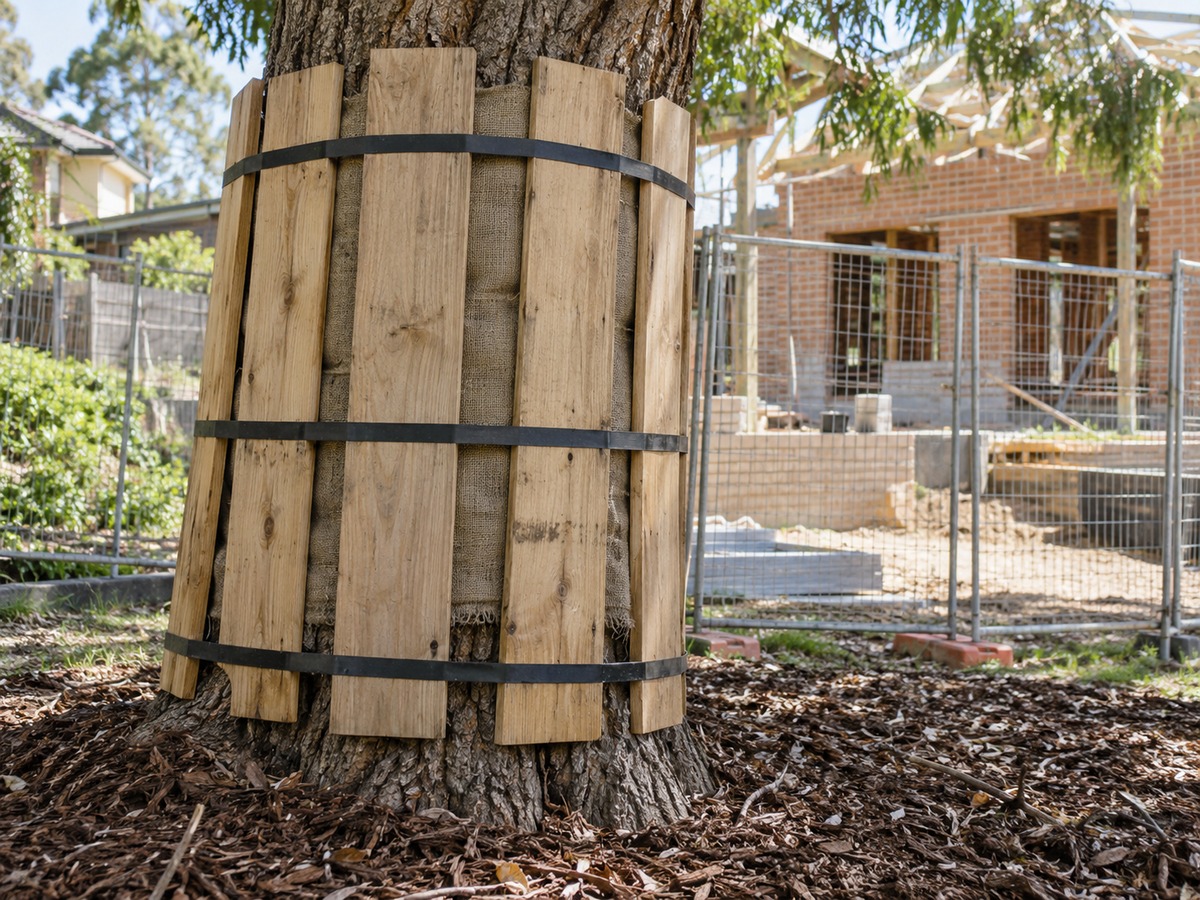
A Tree Protection Plan is a site-specific arboricultural document showing how trees identified for retention will be protected during development and construction. It may identify retained trees, Tree Protection Zones, Structural Root Zones, protection fencing and signage, ground, trunk or branch protection where required, approved access and exclusion areas, excavation and service controls, and arboricultural inspection or hold points.
Tree Protection Plans are commonly prepared following a Development Arborist Report or Arboricultural Impact Assessment and may form part of Development Application documentation or a condition of Development Consent. The purpose is to convert arboricultural recommendations into practical protection measures that can be understood and implemented on site.
When is one required?
A TPP may be required where demolition, excavation, construction, access or service installation could affect trees that are to be retained. This commonly occurs where proposed works are within or near a Tree Protection Zone or Structural Root Zone.
A Tree Protection Plan may be prepared during Development Application assessment, in response to Council requirements, following Development Consent, before demolition or construction, or where approved tree-protection measures need to be documented for the project team.
Where tree protection is a condition of consent, the plan should be prepared early enough for the required measures to be installed before the relevant site works begin.
What does a Tree Protection Plan include?
Each plan is prepared for the actual site, retained trees and proposed construction methodology rather than using a generic template.
- Tree identification and retention
- Tree Protection Zones
- Structural Root Zones
- Tree protection fencing
- Protection signage
- Ground protection
- Trunk and branch protection
- Machinery and vehicle exclusion
- Approved access routes
- Material and waste storage controls
- Excavation and trenching controls
- Service installation
- Root protection
- Arboricultural supervision
- Inspection and hold points
- Monitoring requirements
Where appropriate, tree-protection requirements can be shown against site, architectural or construction plans so fencing, exclusion areas, access routes and other controls are clearly located for builders and contractors.
Tree Protection Zones and Structural Root Zones
The Tree Protection Zone provides an area intended to protect the tree and its growing environment during development. The Structural Root Zone relates particularly to the roots important to tree stability. A Tree Protection Plan can show these areas in relation to the proposed development and identify the protection measures required during construction.
Where proposed works interact with these areas, additional arboricultural assessment, construction controls or investigation may be required. If root location cannot be determined accurately from above ground, non-destructive root investigation may provide more detailed information.
Tree protection during construction and AS 4970-2025
Construction can damage retained trees through excavation, trenching, vehicle movement, material storage, changes to soil levels, service installation, concrete washout, heavy machinery and root damage.
Canterbury-Bankstown Council identifies fenced Tree Protection Zones as its preferred form of tree protection. Its standard conditions typically restrict vehicle access, excavation and installation of services within the fenced protection area. Utility services, pipes, stormwater lines and pits, together with building materials, chemical storage, site sheds, washout areas and waste material, are also generally required to remain outside the fenced area.
Where conventional fencing is not practical and alternative ground, trunk or branch protection is required, Council states that an AQF Level 5 Consulting Arborist will usually be required to design the protection measures or supervise their implementation and maintenance. Council's current development guidance references AS 4970-2025, Protection of trees on development sites.
From development assessment to completion
Tree Protection Plans commonly form part of a broader arboricultural process, so tree-retention recommendations made during development assessment carry through into construction.
Development Arborist Report or AIA
Existing trees are surveyed and the impacts of the proposed development are assessed.
Tree Protection Plan
Arboricultural recommendations are converted into site-specific protection measures.
Protection measures installed
Fencing, signage and any alternative ground, trunk or branch protection are put in place before relevant works begin.
Project Arborist monitoring
Pre-construction inspections, fencing checks, excavation monitoring, root assessment, hold points and documentation of unexpected impacts.
Compliance and completion
Compliance reporting and certification where required by the Development Consent.
Why choose us for tree protection
Site-specific plans
Protection measures prepared for the actual trees, development and construction methodology, not a generic template.
Construction-ready documentation
Clear fencing, exclusion, access, excavation and service controls, coordinated where appropriate with site, architectural, demolition, landscape and engineering drawings.
Project Arborist continuity
Ongoing construction monitoring and certification where required, reducing unnecessary handover between the planning and construction stages.
Frequently asked questions
If your question is not here, send us the details and we will tell you what applies.
When is a Tree Protection Plan required?
A TPP may be required where retained trees could be affected by demolition or construction. It may form part of Development Application documentation or be required by a condition of Development Consent.
When should a Tree Protection Plan be prepared?
Early enough for the required tree-protection measures to be installed before relevant demolition or construction begins. Depending on the project, this may occur during development assessment or after consent.
Who prepares a Tree Protection Plan?
Our Tree Protection Plans are prepared by AQF Level 5 Consulting Arborists and tailored to the retained trees, development plans and applicable tree-protection requirements.
What if tree protection fencing cannot be installed?
Canterbury-Bankstown Council provides for alternative protection measures in appropriate circumstances, such as ground, trunk or branch protection. Council states that an AQF Level 5 Consulting Arborist will usually be required to design or supervise these alternative measures.
Do you provide construction monitoring?
Yes. Where required, our AQF Level 5 Consulting Arborists can continue as the Project Arborist to inspect tree-protection measures, monitor relevant construction activities and provide compliance documentation.
Tree Protection Plans throughout Canterbury-Bankstown
We prepare Tree Protection Plans for residential, commercial, industrial, community and infrastructure projects across all five wards.
Darani / Bankstown Ward
Bankstown, Chullora, Greenacre, Mount Lewis and part of Punchbowl.
Bura / Bass Hill Ward
Bass Hill, Birrong, Chester Hill, Condell Park, Georges Hall, Lansdowne, Potts Hill, Regents Park, Sefton, Villawood and Yagoona.
Budjar / Canterbury Ward
Ashbury, Belfield, Campsie, Canterbury, Clemton Park, Croydon Park, Earlwood and Hurlstone Park.
Bunya / Revesby Ward
East Hills, Milperra, Padstow, Padstow Heights, Panania, Picnic Point, Revesby and Revesby Heights.
Bunmarra / Roselands Ward
Belmore, Beverly Hills, Kingsgrove, Lakemba, Narwee, Riverwood, Roselands, Wiley Park and part of Punchbowl.
Official Council sources
- Canterbury-Bankstown Council, Trees and Development
Official Council information about trees affected by development, tree protection and standard development conditions.
Official source links checked 3 September 2026.
Related pages
Council information last verified 3 September 2026. Project-specific requirements should be confirmed against the Development Consent and approved plans.
Not sure which arborist report you need?
Send us your plans, Council correspondence or photographs of the tree. Our AQF Level 5 Consulting Arborists can identify the appropriate assessment, explain the next step and provide a fixed quote before work begins.