Tree Removal Canterbury-Bankstown
AQF Level 5 Arborist Reports, Council permit support and professional tree removal.
Before removal, we establish whether the tree is protected under Canterbury-Bankstown Council's tree controls, whether an exemption applies, and whether Council approval or supporting arboricultural evidence is required.
If you have simply been told you need a tree report, send us the Council request or photographs of the tree. We can establish what is required before you pay for unnecessary documentation. Once the appropriate approval or lawful exemption pathway has been established, professional tree removal can proceed.
- AQF Level 5 Consulting Arborists
- Professional tree removal
- 32+ years arboricultural experience
- Council permit support
Do I need Council approval to remove a tree?
Council approval is generally required for a protected tree unless an exemption applies. Under Council's current published private-tree guidance, approval may not be required where:
- The tree is less than 5 metres in height
- The centre of the trunk is within 3 metres of a wall of the primary dwelling, not a verandah, measured at 1.4 metres above ground
- The tree species appears on Council’s exempt species list
- The tree presents a risk to human life or property and the owner can demonstrate to Council’s satisfaction that removal is the only reasonable option to avoid an imminent threat
The 3-metre dwelling exemption does not extend to garages, sheds or granny flats. All trees on public land are protected under the Tree Management Order regardless of size, species or origin.
Dying or dead trees
A dying or dead tree may be exempt under Chapter 2.3 where Council is satisfied that the tree is dying or dead, the condition was not caused by tree vandalism or a breach of Chapter 2.3, and the tree is not required as habitat for native fauna. Because those conditions must be satisfied, do not rely on appearance alone where the position is uncertain.
The imminent-threat exemption
This exemption has specific evidence requirements. A tree appearing dead, declining or unstable does not by itself establish that it applies. Council's published guidance identifies additional exempt circumstances, so if your situation does not clearly fall within an exemption, the appropriate pathway should be established before removal.
Our tree removal process
Check the pathway, report where required, approval where required, then the removal.
Check the Council pathway
We identify the tree and assess its species, size, location, condition and site circumstances against the applicable Council controls. Where an exemption applies, this can be identified before unnecessarily proceeding through a Council approval process.
Tree report where required
Where professional arboricultural evidence is required, an AQF Level 5 Tree Removal Report can document the tree’s health, structural condition, relevant defects and evidence-based recommendations.
Council approval where required
Where Council approval is necessary, the Arborist Report can provide supporting arboricultural evidence for the relevant application or approval pathway.
Tree removal
Once any required approval has been obtained, or an applicable lawful exemption has been established, our professional tree crews can undertake the removal.
When is an AQF Level 5 tree removal report needed?
Professional arboricultural evidence may be appropriate where proposed removal involves tree health or significant decline, structural defects, decay or cavities, tree stability, previous branch or stem failures, root-related concerns, suspected damage to buildings or structures, safety concerns, suitability for retention, or a Council request for additional information.
The documentation required depends on the tree, site conditions, reason for removal and applicable Council pathway.
What does a tree removal report include?
- Tree identification and species
- Tree dimensions
- Health and vitality
- Structural condition
- Observable defects
- Decay or damage
- Site and target considerations
- Photographic evidence
- Retention and removal assessment
- Arboricultural reasoning and recommendations
Where visual assessment alone does not provide sufficient evidence, further investigation may be appropriate, including non-destructive root investigation or advanced structural and decay investigation.
How does Council assess tree removal?
Council identifies a number of reasons that are generally not sufficient on their own to justify removal.
These can include normal leaf or fruit drop, wildlife, seasonal shading, minor lifting of paving or fences, or wanting to construct a fence, carport or similar structure. Where removal relies on health, structural condition, safety or damage concerns, professional arboricultural evidence can document the tree's condition and the basis for the recommendation. Where a tree remains suitable for retention, pruning or another management option may instead be appropriate.
Dangerous or structurally compromised trees
A tree with significant structural defects, decay, previous failures or compromised branch attachments may require more detailed assessment before the appropriate management response can be determined.
Roots and property damage
Visible roots near cracked paving, driveways, retaining walls, pipes or buildings do not necessarily establish that the tree caused the damage. Council specifically identifies minor lifting of fences, pathways, garden edging and carport slabs as generally insufficient grounds on their own.
Immediate danger or storm damage
For fallen trees, active failures or trees presenting an immediate hazard, urgent assessment and make-safe work may be required.
Tree removal for a Development Application
Tree removal proposed as part of a Development Application follows a different pathway from standalone tree removal. Where trees are proposed for removal as part of a DA, their retention value, Notional Root Zone, Tree Protection Zone, Structural Root Zone, proposed development impacts and tree-sensitive design alternatives may need to be assessed through a Development Arborist Report or Arboricultural Impact Assessment.
Professional removal after approval
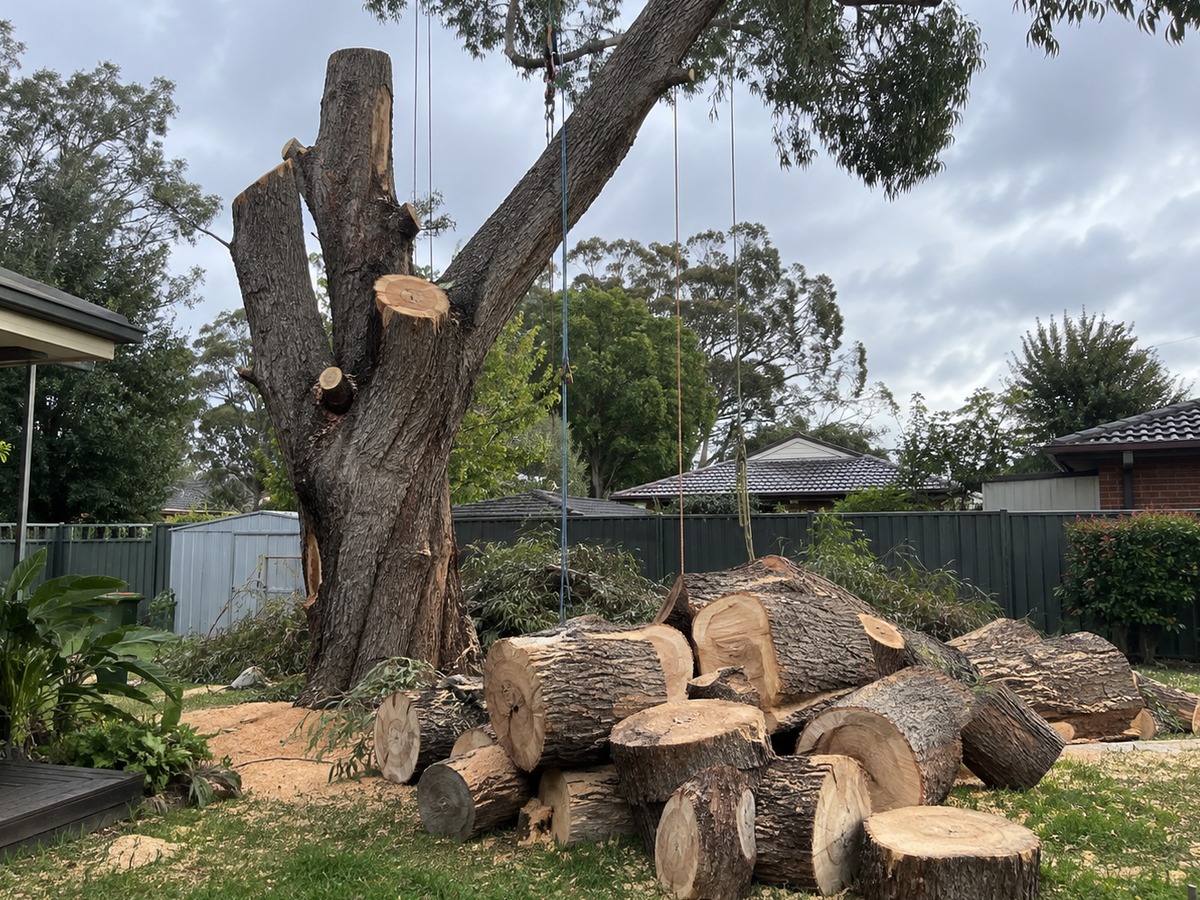
Once Council approval has been obtained where required, or the appropriate exempt pathway has been established, our tree crews can undertake the removal. Depending on the tree and site, work can include tree dismantling, confined-space removal, large-tree removal, hazardous-tree removal, storm-damaged tree removal and site clean-up.
Our Consulting Arborists and tree crews operate within the same service pathway, allowing the approved scope of work to progress from arboricultural assessment through to completion.
Why choose us for tree removal
Council pathway first
Not every tree needs an Arborist Report or Council permit before removal. We establish what is actually required before recommending unnecessary documentation.
Reports and tree work together
AQF Level 5 assessment, evidence-based reporting and professional removal through one coordinated service.
Specialist investigation
Health, structural and root investigation where additional evidence is required, plus emergency response for fallen and immediately dangerous trees.
Frequently asked questions
If your question is not here, send us the details and we will tell you what applies.
Do I need Council approval to remove a tree in Canterbury-Bankstown?
Possibly. Council approval is generally required for a protected tree unless an exemption applies. Common exemptions include trees under 5 metres, certain trees within 3 metres of the primary dwelling, listed exempt species and trees genuinely satisfying the imminent-threat exemption.
What trees are protected in Canterbury-Bankstown?
Non-exempt trees over 5 metres generally require Council permission for removal or significant pruning. Other exemptions can apply based on species, proximity to the primary dwelling and specific tree circumstances. All trees on public land are protected under the Tree Management Order.
Do I need an AQF Level 5 arborist report?
Not every tree removal requires one. Where Council or the circumstances require formal supporting evidence, an AQF Level 5 Arborist Report can document the tree’s condition and provide the arboricultural basis for the recommendation. Our Tree Removal Reports are prepared by AQF Level 5 Consulting Arborists.
Can you prepare the report and remove the tree?
Yes. We provide AQF Level 5 Arborist Reports and professional tree removal through one coordinated service, from assessment through to completion.
Can I remove a dead tree without Council approval?
A dying or dead tree may be exempt where Council is satisfied that the tree is dying or dead, the condition was not caused by tree vandalism or a breach of Chapter 2.3, and the tree is not required as habitat for native fauna. Where those conditions are unclear, we can assess the tree and help confirm the appropriate pathway before removal.
What if my tree is dangerous right now?
If a tree has fallen, is actively failing or presents an immediate hazard, urgent assessment and make-safe or emergency tree work may be required. A tree simply appearing unstable does not automatically satisfy the applicable imminent-threat requirements.
What if tree roots are damaging my house, driveway or pipes?
The cause should be properly established first. Visible roots near damage do not necessarily establish causation. Depending on the circumstances, arboricultural assessment together with evidence from a plumber, builder or engineer may be appropriate, and non-destructive root investigation can help establish the location, diameter and depth of significant roots.
Tree removal throughout Canterbury-Bankstown
Assessment, AQF Level 5 reports, Council permit support and professional removal across all five wards.
Darani / Bankstown Ward
Bankstown, Chullora, Greenacre, Mount Lewis and part of Punchbowl. Enquiries commonly involve mature trees on established residential properties, trees close to dwellings and boundaries, redevelopment sites and trees where health or structural condition requires professional assessment.
Bura / Bass Hill Ward
Bass Hill, Birrong, Chester Hill, Condell Park, Georges Hall, Lansdowne, Potts Hill, Regents Park, Sefton, Villawood and Yagoona. Matters can involve established residential properties, larger trees, boundary conflicts, root-related concerns and trees affected by changing site conditions or redevelopment.
Budjar / Canterbury Ward
Ashbury, Belfield, Campsie, Canterbury, Clemton Park, Croydon Park, Earlwood and Hurlstone Park. Established residential areas where mature trees can occur close to houses, neighbouring properties and existing structures, requiring careful assessment of condition, retention value and Council requirements.
Bunya / Revesby Ward
East Hills, Milperra, Padstow, Padstow Heights, Panania, Picnic Point, Revesby and Revesby Heights. Enquiries can involve mature residential trees, larger properties, trees affected by storm damage or structural concerns, and properties influenced by bushland and river environments.
Bunmarra / Roselands Ward
Belmore, Beverly Hills, Kingsgrove, Lakemba, Narwee, Riverwood, Roselands, Wiley Park and part of Punchbowl. Matters can involve mature trees close to buildings and boundaries, root and property conflicts, redevelopment and trees requiring health or structural assessment.
Official Council sources
- Canterbury-Bankstown Council, Tree Management Order
Official Council requirements relating to trees and tree management.
- Canterbury-Bankstown Council, Private Trees
Exemptions, permits and replacement planting for trees on private land.
Official source links checked 3 September 2026.
Related pages
Council information last verified 3 September 2026. Requirements can change, so confirm with Canterbury-Bankstown Council for property-specific advice.
Not sure which arborist report you need?
Send us your plans, Council correspondence or photographs of the tree. Our AQF Level 5 Consulting Arborists can identify the appropriate assessment, explain the next step and provide a fixed quote before work begins.